Antiquer
Antiquer is a browser extension, available for Firefox and Chrome, that applies certain now-archaic elements of English spelling style to web pages.
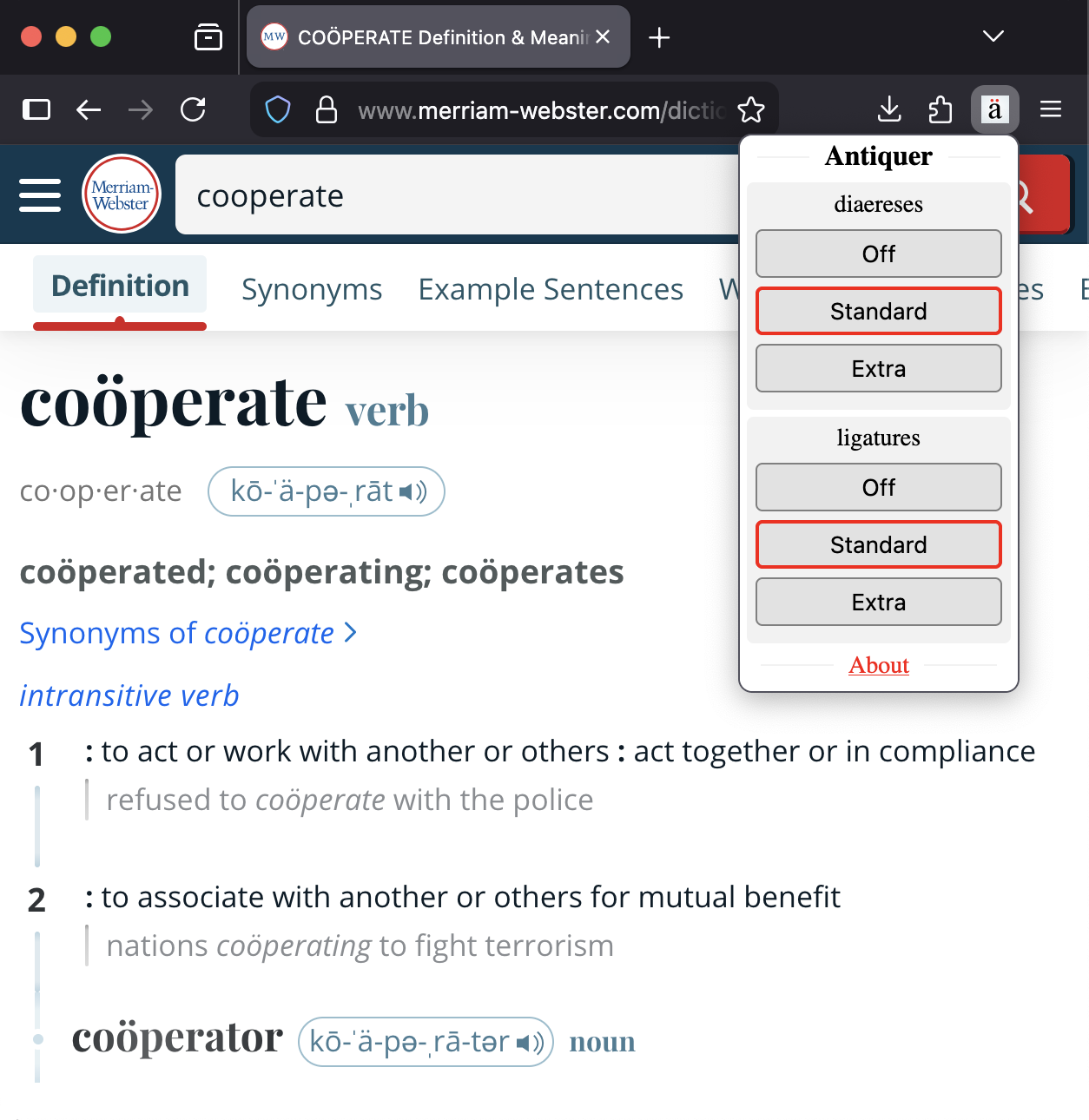
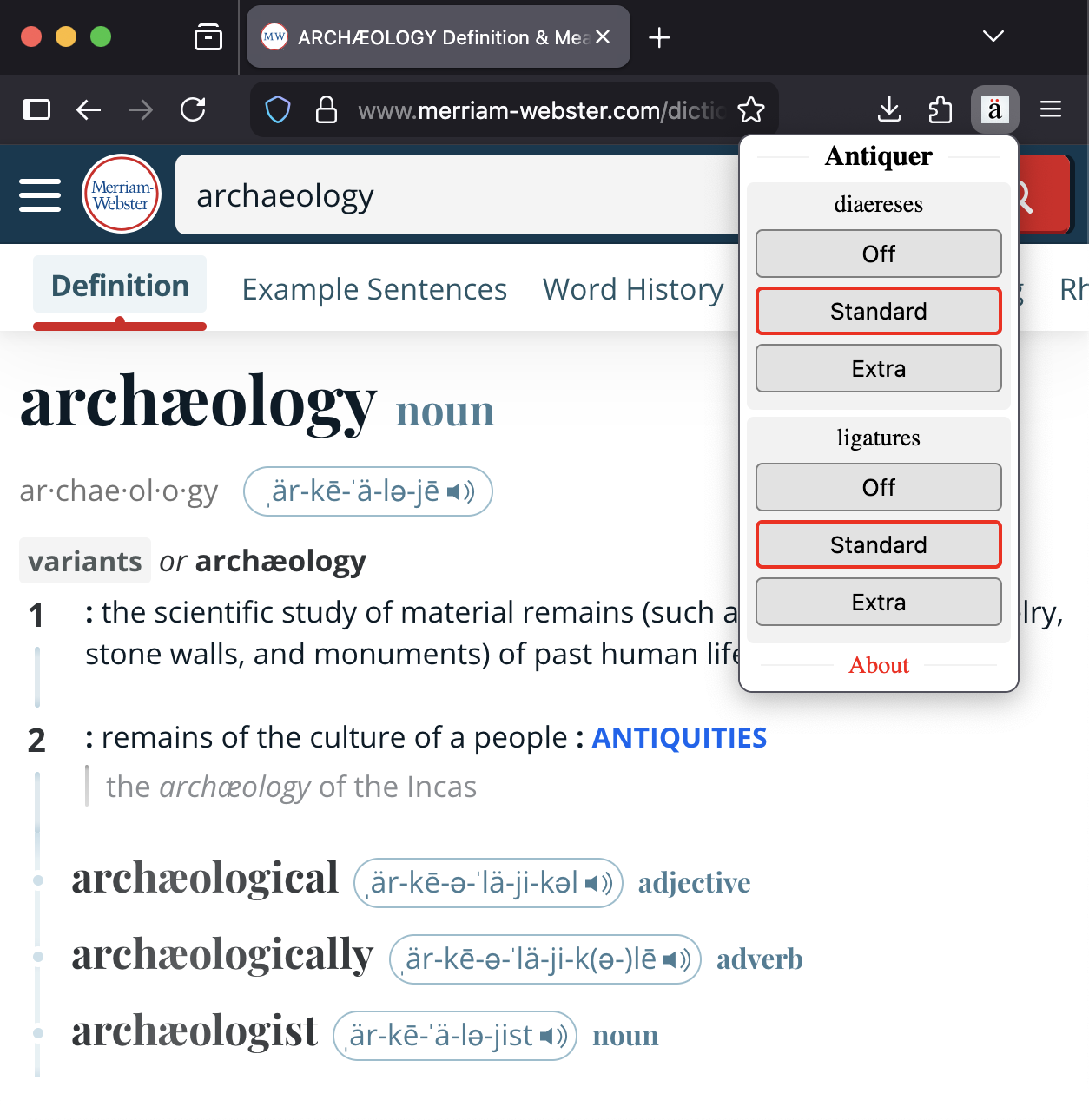
The available changes include the use of diaereses (coöperate, reëlect) and the æ and œ ligatures (archæology, fœtus).
Privacy Note
In order to function, Antiquer must read all incoming web page data as your browser presents it. Antiquer does not transfer any of this data off of your computer, use it for any purpose other than making its alterations to the page, or store it after those alterations are made.
Guide to Style Changes
Antiquer makes available two types of style changes: diaereses, and the æ and œ ligures. Each of these elements can be activated at either a standard or extra level.
The standard level, in general, applies changes that are relatively more recent and consistent in usage, while extra applies changes that are older, less standard, or hypercorrect.
Diaereses
Diaereses, appearing as two dots above a vowel letter (◌̈), are used when two vowels appear together to show that they should be pronounced as two distinct sounds, rather than as a single sound together. For example, diaereses may be used in the word coöperate to show that the first syllable should not be pronounced as in a chicken's coop. They also occur in French with the same function, and so occasionally appear in English texts in French loanwords.
Standard-level Diaereses
-
Words consisting of a prefix ending in a vowel followed by a root beginning with that same vowel.
- coöperate, deëscalate
-
Any combination of a prefix ending with a vowel followed by a word beginning with that same vowel, separated by a dash.
- co-organizer → coörganizer
- de-entrench → deëntrench
-
Names commonly written with diaereses.
- Chloë, Noëlle
-
Medical and scientific words containing separately pronounced double-o's.
- oöcyte, zoölogy
-
Borrowings from French that include a diaeresis.
- aïoli, naïve
Extra-level Diaereses
-
Words consisting of a prefix ending in a vowel followed by any vowel.
- reïgnite, hypoällergenic
-
Any combination of a prefix ending with a vowel followed by a word beginning with a vowel, separated by a dash.
- co-architect → coärchitect
-
Names less commonly written with a diaeresis.
- Raphaël, Averroës, Beëlzebub
-
Various words that, archaically or pedantically, may be written with a diaeresis as they contain adjacent vowels that are pronounced separately.
- daïs, whereäs
Ligatures
Ligatures, the combining of two letters into a single character, are a part of many typefaces. In earlier English spelling styles however, the æ and œ ligatures in particular were sometimes used to indicate words derived from Greek or Latin where those letters represented a single sound together. They also occur in French, and so occasionally appear in English texts in French loanwords.
Standard-level Ligatures
-
Greek and Latin names containing ae or oe digraphs in English.
- Cæsar, Phœbe
-
Words of Greek and Latin origin that may be spelled with ae or oe digraphs in English.
- archæology, fœtus
-
Borrowings from French that use æ or œ ligatures.
- hors d'œuvre, manœuvre
-
Plurals of Latinate words in -ae.
- antennæ, larvæ
Extra-level Ligatures
-
Names deriving from Latin or Greek containing ae or oe digraphs, but not typically written that way in English.
- Æmily, Cæcil
-
Names deriving from Old English formerly written with æ.
- Ælfred, Æthel
-
Words derived from Latin words that contained an ae or oe digraph in Latin but which are not typically spelled with it in modern English.
- præmium, fœderation